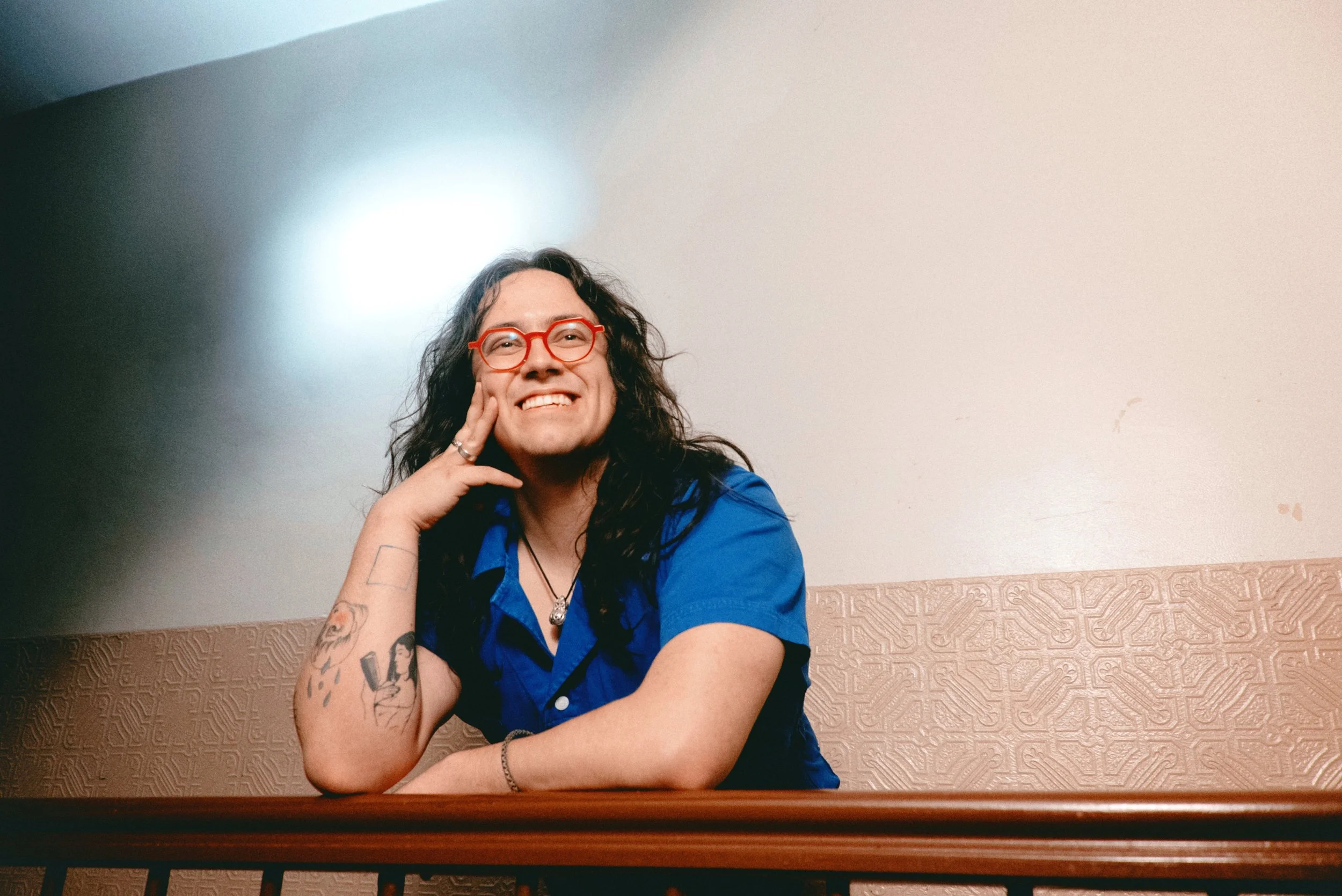
inti figgis-vizueta — Music for Transitions
inti figgis-vizueta
Music for Transitions
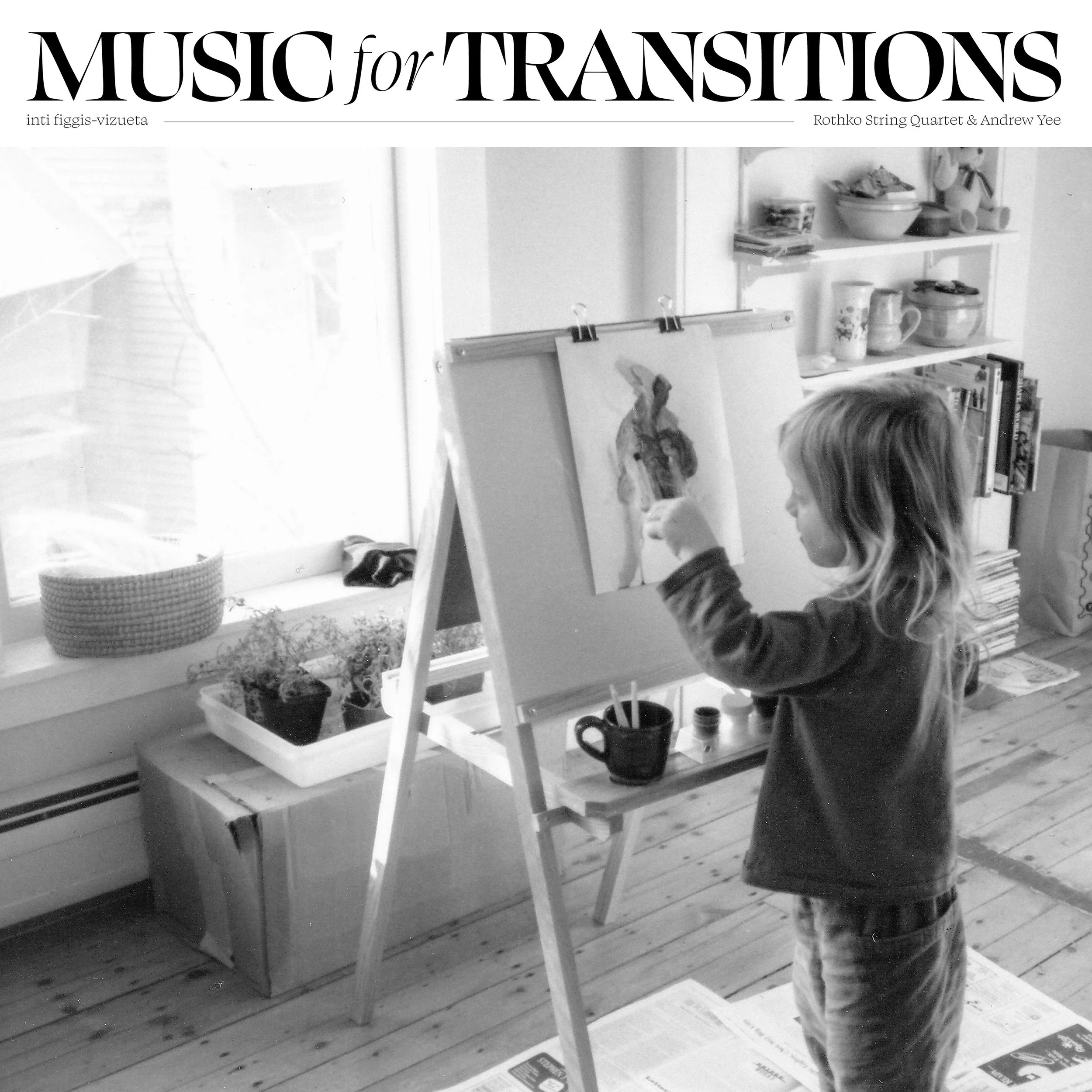
Release date: November 06, 2026
Music for Transitions is the first full-length album to exclusively feature works by inti figgis-vizueta, performed by Rothko String Quartet and GRAMMY Award-winning cellist Andrew Yee. Building from figgis-vizueta’s 2020 cello quartet of the same name, described as “raw, scraping yet soaring” by The Washington Post, the album’s five pieces invoke Indigenous cosmologies and trans futurism through organic, ecstatic soundscapes. These blazing compositions pronounce the latest heights of a catalogue in which figgis-vizueta creates, per composer George Lewis, “a music of awareness, and you cannot be passive in listening to it.”
Four pieces on Music for Transitions feature the Germany-based Rothko String Quartet, whose members have championed figgis-vizueta’s works for years, premiering numerous works as soloists, chamber musicians, and curators at various festivals across Germany. Cellist Andrew Yee, who has collaborated numerous times with figgis-vizueta as soloist and member of the Attacca Quartet, performs on two works as a duo with Rothko’s cellist, Jakob Nierenz, and also with the complete Rothko, creating a cello quintet.
Music for Transitions mirrors her growth, exploration, and relationships spanning eight years of figgis-vizueta’s time in New York City. She explains: “This album is deeply connected to my life in New York City with its vibrant creative fabric and rich community of artistic collaborators. From early lessons at Columbia University, to commissions from The Juilliard School and Carnegie Hall, and performances in all five boroughs, New York City has been both a welcoming home and vivid, creative laboratory. Throughout, the string quartet has been much the same: an infinitely inspiring ensemble and musical form, with deep improvisational potential born of an intimate sensitivity to collective sound.”
-
Music for Transitions draws upon figgis-vizueta’s mixed (Quichua and Irish) heritage, her upbringing across ethnically diverse creative spaces in Washington, D.C., and her experience as a transgender, two-spirit artist, to create a music that is as vulnerable as it is communicative, courageous, and joyfully, wholeheartedly itself. Bringing her scores to life are long-time collaborators Andrew Yee & Rothko String Quartet, whose expertise in historical and experimental styles creates a vivid, nuanced tapestry of texture and group sound.
Providing written context to this first recorded collection of figgis-vizueta’s work are two essays by George Lewis and Jennifer Gersten, while the recordings themselves answer the question composer Nico Muhly posed in a 2019 interview: “In your ideal world, if you fast forward 25 years, how would you like your work to be recorded?”
In his essay, George Lewis writes: What I hear in inti’s music are the dynamics of the decolonial, which for me are marked by contingency, heterogeneity, nonlinearity, emergence, mediation, remediation, and bricolage--but also by what she calls “organic non-linearity”—a position that leads inexorably to a refusal of all complacency. Thus, the instructions inti gives to her musicians often require a form of introspection that foregrounds agency and leads to action: “What do you hear? What do you hear too much of? What do you hear not enough of? Can you change it?”
The five works that make up Music for Transitions engage individual and collective choice through figgis-vizueta’s improvisatory frameworks. Her use of graphic notation as a tool for framing player choice follows in the footsteps of her musical influences (Cage, Lucier, and Oliveros). The openness of the music allowed Yee and Rothko String Quartet to capture the “detail and gravity that came from the body of each performer, the flow of the compositions, and where they were in that moment.”
Violinist and writer Jennifer Gersten, walks us through figgis-vizueta’s musical worlds in the album liner notes:
“Music for Transitions (2020)”, the album’s titular work, is not a string quartet in the usual sense, but is indebted to an exponent of the form—Andrew Yee, for whom the piece was originally performed as part of a National Sawdust’s “Digital Discovery.” The work comprises five layered cello tracks, which were created by both Yee and Jakob Nierenz, Rothko’s cellist (and Yee’s student years ago at Boston University Tanglewood Institute). A six-minute ecstatic tumult, the work foregrounds a technique in which Yee and Nierenz alternate rapidly between different strings, producing the work’s bright motor. At the heart of Music for Transitions is joy in the self’s intrinsic capacity for change, rooted in Yee and figgis-vizueta’s shared experience as queer, trans-feminine artists.
The album’s next work, “Talamh”—the Irish word for “land”—contains an infinitely variable terrain in its sparse score. Written for Spektral Quartet in 2020, Talamh is, in essence, “a structure for making choices,” as the composer puts it: in these short, stately processions of chords, performers are to decide the octave and timbre in which they wish to play the pitches. Propelling the work to the next sections are yet more decisions, as performers are to propose their own intervening material. Myriad results ensue, each with its own compelling geography.
From land, the album moves to the heavens. Andean cosmology has it that the Milky Way was in fact a life-giving river of stars named “Mayu”, which bridged earth and the heavens. In this system, constellations were not commemorative assemblages of stars, but rather living entities formed in the dark spaces between stars, a menagerie of negative space. Written for JACK Quartet in 2021, the eponymous work sounds the ecosystem of those constellations in three parts: first, bursting tremolos; then, flexible percussive gestures; and finally, in the third, an ethereal union of the two preceding.
Next is a work concerned with the transit between earth and sky. Fascinated with “things that move on their own,” she cites the winged, single-seeded maple tree fruit, sometimes called the “Samara,” that twirled waywardly to the ground of her childhood backyard in Washington, D.C. The cello quintet Samara, written for Rothko and Yee for the occasion of this album, locates, in the samara’s transit, an odyssey of four-movement scale. Samara (2025) opens in stately fashion, though with an underlying glimmer of chaos that takes charge at the end of the first section, titled “falling.” “Slow spins” is the resonant harmonic clearing that follows, which is succeeded by “find roots,” where, from a shy exchange of preparatory tones, a thicket of arpeggios shoots forward. The last movement, “to fly again,” blooms out of a hoarse quiet into a glittering chord. As a whole, the work occupies a particularly special position for the composer, symbolizing the result of when great trust in collaborators enables great trust in self.
Closing the record is “Stolen Rivers”, for string quartet and flexible ensembles of hand bells. Commissioned in 2024 by the violinist Jennifer Koh’s ARCO Collaborative for a performance in the atrium of the Kennedy Center, the work is inspired by a reflection on poorer D.C. neighborhoods’ limited transit access to the Potomac River and the cultural hotspots along the River’s shores, including the Kennedy Center, that figgis-vizueta frequented. On this album version of Stolen rivers, for bells and strings, an ad-hoc group of the composer’s friends plays the hand bells. After a short chorale, the strings themselves take up bells, so that the album goes out ringing.
Music for Transitions draws upon figgis-vizueta’s mixed (Quichua and Irish) heritage, her upbringing across ethnically diverse creative spaces in Washington, D.C., and her experience as a transgender, two-spirit artist, to create a music that is as vulnerable as it is communicative, courageous, and joyfully, wholeheartedly itself.
-
Tracklist and Credits
Music for Transitions - cello duet, with five overdub tracks (2020), 06:09
commissioned by Andrew Yee
Talamh (land) - string quartet (2020), 09:32
commissioned by Spektral Quartet
Mayu (the great river) - string quartet (2021), 10:38
commissioned by JACK Quartet
Samara (maple seed) - cello quintet (2025), 17:16
commissioned by Rothko String Quartet
movements:
- i. falling, 00:00 - 05:56
- ii. slow spins, 05:57 - 10:50
- iii. find roots, 11:00 - 13:33
- iv. to fly again, 13:42 - 17:16
Stolen Rivers - string quartet with small bell ensemble (2024), 05:38
commissioned by ARCO Collaborative
Rothko String Quartet:
Joosten Ellée, William Overcash - violins
Marc Kopitzki - viola
Jakob Nierenz - cello
Guest Musicians:
Andrew Yee - cello
Marguerite Cox, Pala Garcia, Ella Joklik, Raquel Acevedo Klein, Kieun Song - small bell ensemble
PRESS & NEWS
ARTIST


COMPOSER