
Francesca Gaza - Crown Shyness
Francesca gaza & Kugelförmigkeit Ensemble
Crown Shyness
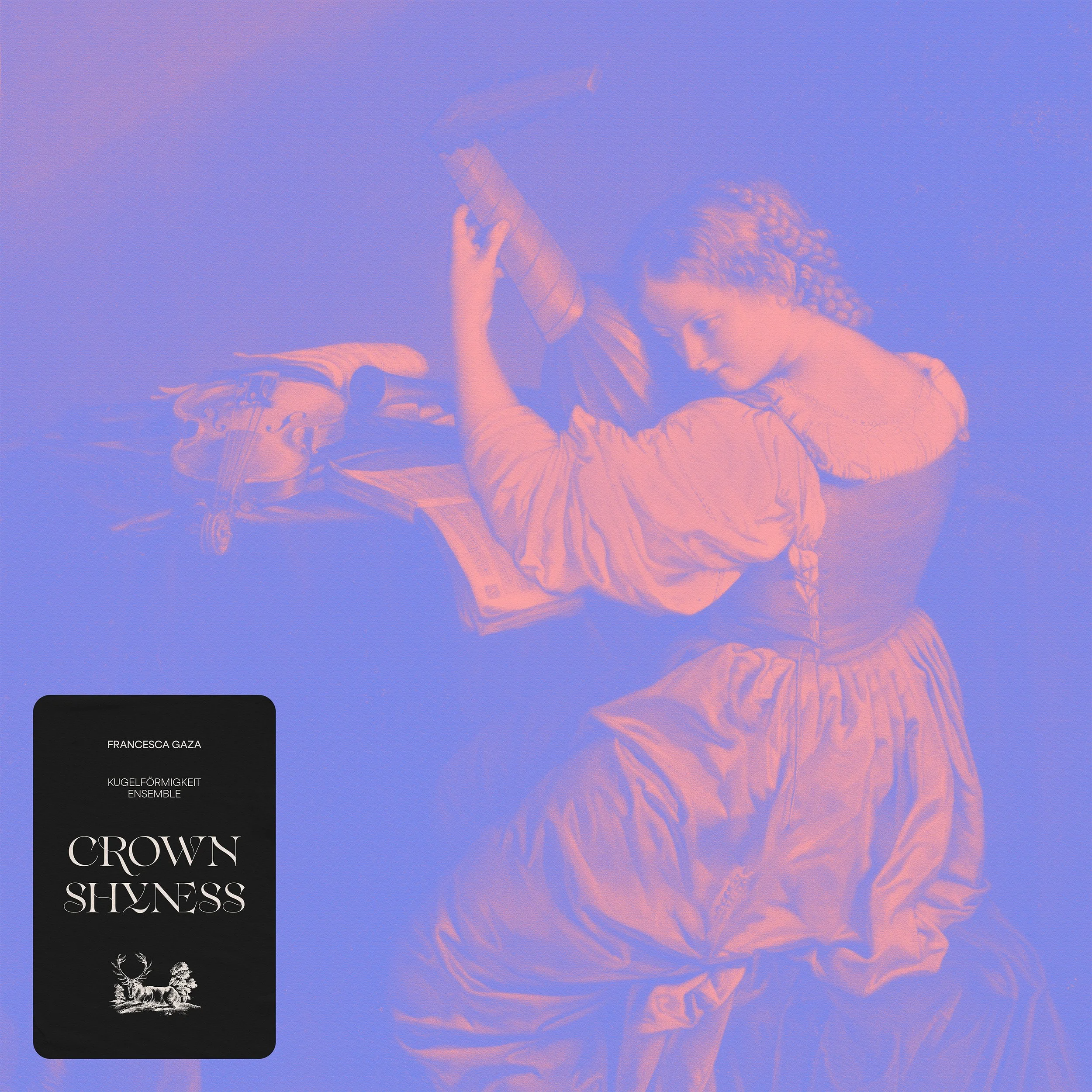
Release date: August 21, 2026
Francesca Gaza, the composer, singer, pianist, and conductor, announces the release of her new album, Crown Shyness, alongside the Kugelförmigkeit Ensemble, via New Amsterdam Records.
On Crown Shyness, Francesca Gaza and her Kugelförmigkeit Ensemble trace intimate soundscapes built from distinct architectural layers that never collapse into each other, but rather remain delicately interwoven: close, fragile, and alive with quirky tension and breath. The compositions, written specifically for the ensemble’s rare cross-genre mix of early music, jazz, and contemporary instruments, create a genre-defiant, textured, and layered work. Much like the treetops, each instrument, timbre, and gesture holds its own space—intimately close, yet never collapsing into the other—while contributing to a larger organic structure. The result is a kind of musical ecology; a fragile, breathing system that maps presence and memory without overpowering it.
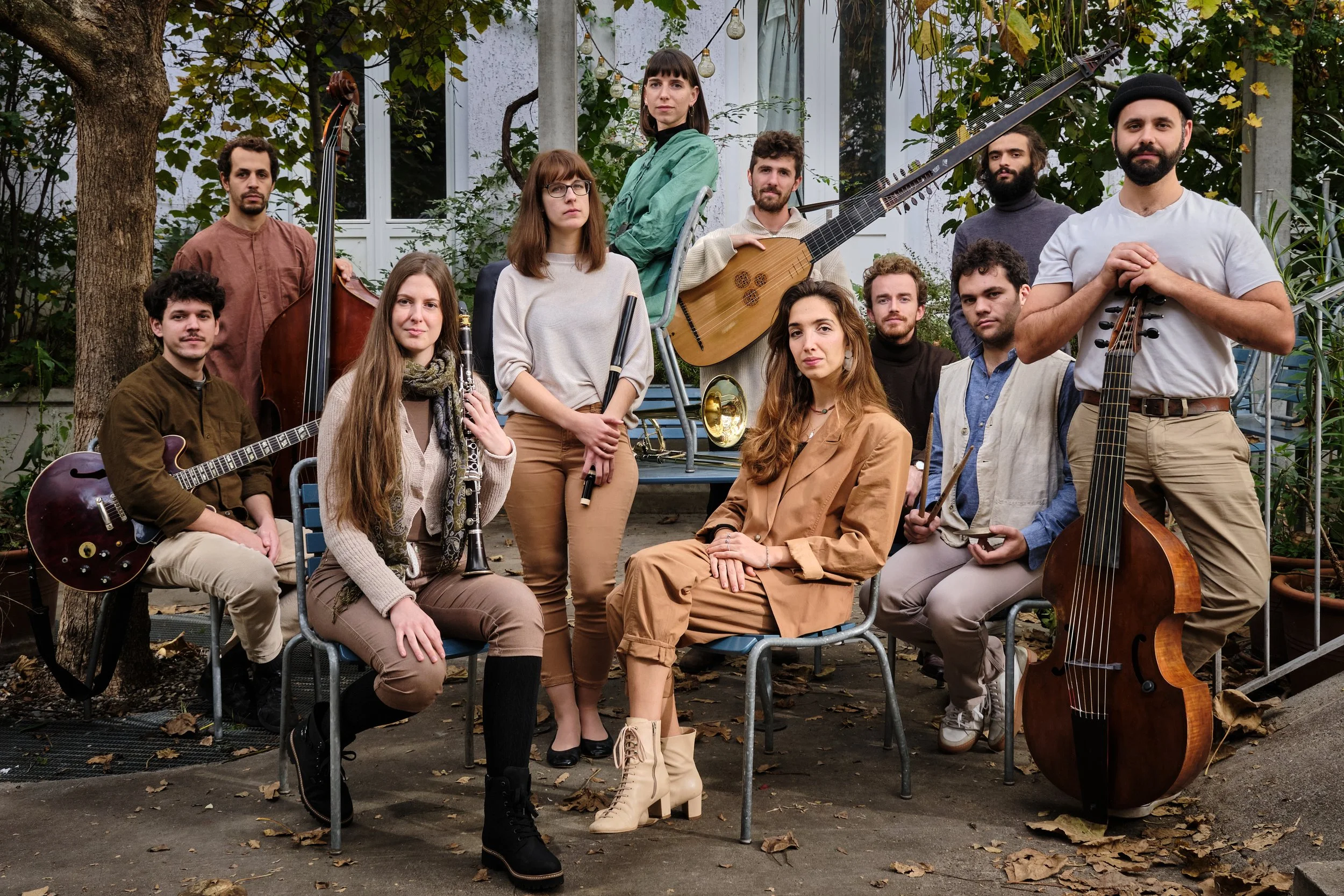
The Kugelförmigkeit Ensemble, founded and directed by Gaza in 2021, functions as a compositional laboratory, bringing historical and contemporary instruments into a shared sonic language. The album features performances by: Ana Čop and Francesca Gaza (voice), Eleonora Bišćević (baroque flute), Julija Vrabec (clarinet, bass clarinet), Adrian King (trombone), Martín Theurillat (electric guitar), Nacho Laguna (theorbo), Iannis Obiols (virginal & piano), Giulio Tanasini (viola da gamba), Nadav Erlich (double bass), and Mattia Galeotti (drums).
-
“The image that started everything was the crown shyness itself,” explains Gaza. “I first stumbled upon this term in French (timiditée botanique) and found it so compelling as a description: the phenomenon where the crowns of tall trees grow so that they never quite touch, leaving delicate traces of light between them. There is a specific pine forest near my grandmother's house in Tuscany where this pattern is very strong, and it always left me baffled and enchanted. It felt like a description of what I was trying to do musically: bringing different sound worlds, historical periods, and languages into close proximity without forcing them to merge. The album was also shaped by something more personal; a preoccupation with coexistence, with the difficulty and necessity of holding multiple, apparently contradictory truths at once, by poetry, and by the particular expressive richness of early instruments when they are asked to speak in a contemporary context."
Gaza’s relationship with early music began upon arrival to Basel for her studies. “I arrived at the train station and literally saw somebody walking around with a Theorbo case, and I was like, “what is that?” I then asked my school if I could get classes at the Schola Cantorum Basiliensis and they said yes, so I became a regular intruder in the Schola Cantorum and that really changed my life.”
Crown Shyness was developed after Gaza received a grant from the Cultural Department of Basel-Stadt. The grant allowed Gaza to dive back into her sonic laboratory and develop the scores which were workshopped for five days with the ensemble and then recorded. Says Gaza: “Crown Shyness feels, personally, like my most experimental work to date, and probably the one that comes closest to expressing what the Kugelförmigkeit Ensemble actually represents for me. It's a record about proximity without merging: different sound worlds, historical periods, and musical languages held close to each other without being forced to dissolve into one another. Early music, new music, jazz, song, improvisation, graphic notation, rock-ish dense timbral layering, all of it somehow present, none of it dominant but all very much loved and cherished. These are in no way ingredients I assembled — they are the things that have always moved me, each admired in its own time, its own place. The album is simply where I finally let them all be in the same room.”
Through Crown Shyness, Gaza turns to poetry for lyrical inspiration. Album opener, “Loop Piece / Verörtlichen” builds towards a setting of My Infinity by Didi Jackson, a poem that, as Gaza recalls, “had been quietly living in me for a long time during the compositional process and then finding its place here. Setting those lines felt like touching something fragile and vast.” The piece opens with a slow reveal of the instrumental colors at play until a looping structure filled with aleatoric gestures starts to emerge. “The piece holds its contradictions close—written structure and improvisation, triadic harmony and atonality, continuity and interruption, loop and change. I wasn't interested in resolving them but in letting them breathe side by side.”
The album is threaded with four interludes, each carrying the same melodic gesture (leitmotif)—a large-interval melody that rings through the record like a bell-tolling of memory. Each time it returns, it serves to transport the listener back—not didactically, but quietly, the way memory actually works: recognizing something before you can name it. It is also a small, deliberate game with the cyclical nature of time that gives the ensemble its name.
“Spring is like a perhaps hand,” with text taken from poetry by E. E. Cummings, a poet whose “language, with its clarity and its strangeness,” explains Gaza, “invites music in without telling it what to do,” is a slow burner built around a loop in 11/4. “The piece grew out of a loop in G major—a pattern in 11/4 that I kept returning to at the piano, feeling it expand with each pass, one new tone added every cycle, as if the harmony were slowly opening its hand,” says Gaza.
Opening with a long theorbo introduction written for Nacho Laguna—tailored to him and to the historically dense character of his vast instrument—“Be a lamp, a lamp, a lamp” begins to frame words by Slovenian poet Srečko Kosovel, whose writing moves between vast inner states and luminous, strong images. “That image of a solitary street lamp stayed with me. It came at a moment when I needed a particular kind of stillness—when distances were growing inside friendships and communities, and I found myself searching for something that could hold all of it without collapsing and quietly observing without judging. The lamp became a way of thinking about solace, and about silent witness and the importance of that.”
“Varco / Principio” opens with a baroque flute solo by Eleonora Biscevic. Gaza remarks, “it’s an instrument of remarkable expressive range. Without keys, shaped around the D scale, it carries an uneven, color-rich palette: glissandi, microtones, shifting harmonics that a modern flute cannot quite replicate the same way. Eleonora brings to it both eloquence and a generosity of interpretation that I find very moving.” In the second section, the ensemble divides into two sound groups, and a small chorale grows between them before spinning outward into a web of flutter-tongue flute, clarinet, and voices, with the lower instruments building a groove underneath that turns almost tribal. From there, the music reaches its densest point: a 'groviglio’––Italian for tangle––of the two voices interwoven with a solo melody by trombonist Adrian King.
Crown Shyness comes to a close with “Spazio toccato con mano,” a duo written for double bass and clarinet which explores and extremely fragile sonic coexistence—at times abrasive, where the slightly out-of-tune harmonics of the bass rub against the clarinet's pure pitch; at others in complete sinuosity and bliss, in the moments where the two voices move in clear counterpoint to each other. Says Gaza, “I wanted the album to end with beauty and fragility, but also in strength—as a duo, sounding together. Superbly performed by Julija Vrabec on clarinet and Nadav Erlich on double bass.”
-
Tracklist and Credits
Loop Piece / Verörtlichen
interludium I
Spring is like a perhaps hand
Ritual / Cascate
interludium II
Be a lamp, a lamp, a lamp
interludium III
Varco / Principio
interludium IV
Spazio toccato con mano
Andy Neresheimer: Mix and Recording
Andy Neresheimer : Mastering
Roman Hosek: Advisory Radio SRF, Executive Production
On Track Nr 3 ‘Spring is like a perhaps hand’ - Samuel Lutz: Video and Camera Editing
Vieri Cervelli Montel : Graphic design and Artwork
The recording was produced by SRF (Swiss Radio and Television).
The project was co-financed by the Cultural Department of Basel-Stadt.
Kugelförmigkeit Ensemble is:
Francesca Gaza - Composition, Voice, Direction
Ana Čop - Voice
Eleonora Bišćević - Baroque Flute
Julija Vrabec - Clarinet, Bass Clarinet
Adrian King - Trombone
Martín Theurillat - El. Guitar
Nacho Laguna - Theorbo
Iannis Obiols - Virginal, Piano
Giulio Tanasini - Viola da Gamba
Nadav Erlich - Doublebass
Mattia Galeotti - Drums
PRESS & NEWS










ARTIST

COMPOSER